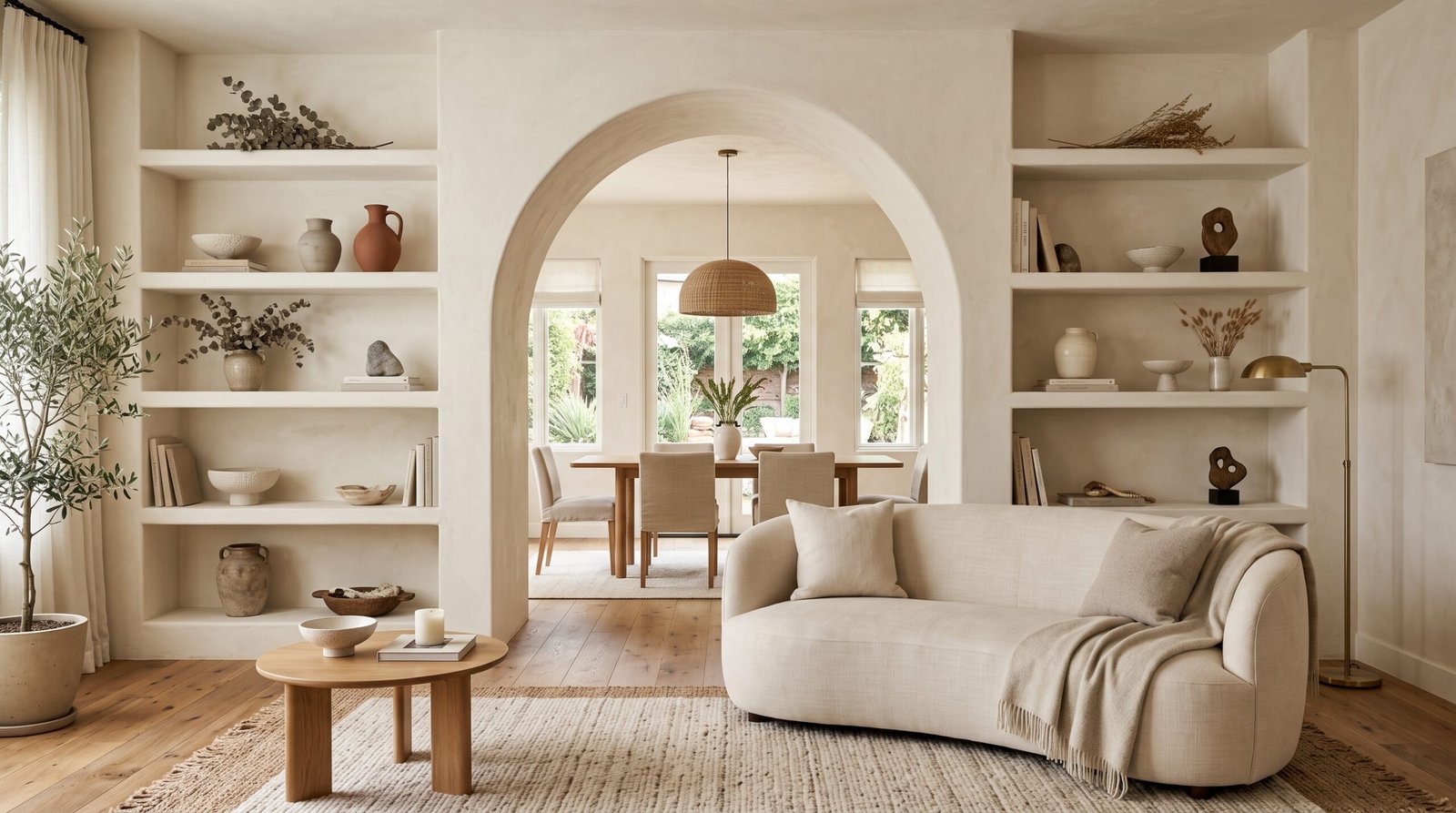
17 Indoor Archway Ideas to Add Character and Architectural Charm
Indoor archways have a way of making an ordinary transition between rooms feel
intentional. Instead of treating a doorway simply as a functional opening, an arch introduces shape, softness, and architectural interest. It can make a newly built home feel established, give a minimalist interior more personality, or help two adjoining spaces flow together without completely removing the visual boundary between them.
The appeal of indoor arches is also surprisingly versatile. You might picture a warm Mediterranean villa when you hear the word “archway,” but arches can work just as beautifully in Scandinavian, organic modern, contemporary, farmhouse, traditional, and even minimalist interiors. The secret is choosing the right proportions, materials, and surrounding decor.
Some homeowners use a dramatic oversized arch between the living and dining rooms. Others introduce the look on a smaller scale with an arched niche, pantry entrance, hallway opening, or built-in bookshelf. Even a simple rounded doorway painted the same color as the surrounding wall can completely change the character of a room.
If you’re looking for ways to introduce more architectural personality into your home, these indoor archway ideas offer inspiration ranging from subtle and contemporary to bold and timeless.
1. Choose a Simple Rounded Archway
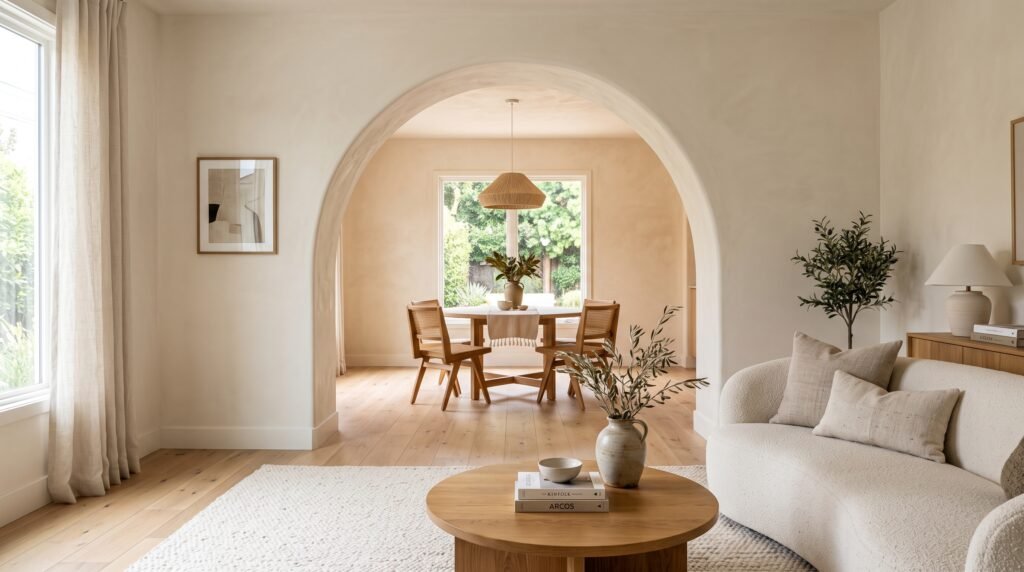
One of the easiest ways to embrace this architectural trend is with a classic rounded opening between two rooms.
A simple arch doesn’t require elaborate trim or decorative details to make an impact. In fact, keeping the opening clean often makes the curve itself more noticeable. White, cream, warm beige, and other soft neutral walls work particularly well because light and shadow naturally emphasize the rounded shape.
Consider using an arch between a living room and dining area. You still get a spacious, connected layout, but the arch creates a visual frame around the neighboring room.
This is particularly useful in open-plan homes where spaces can sometimes feel undefined.
Keep the surrounding decor restrained. A warm wood console, ceramic vase, linen curtains, textured rug, or statement chair can provide enough visual interest without competing with the architecture.
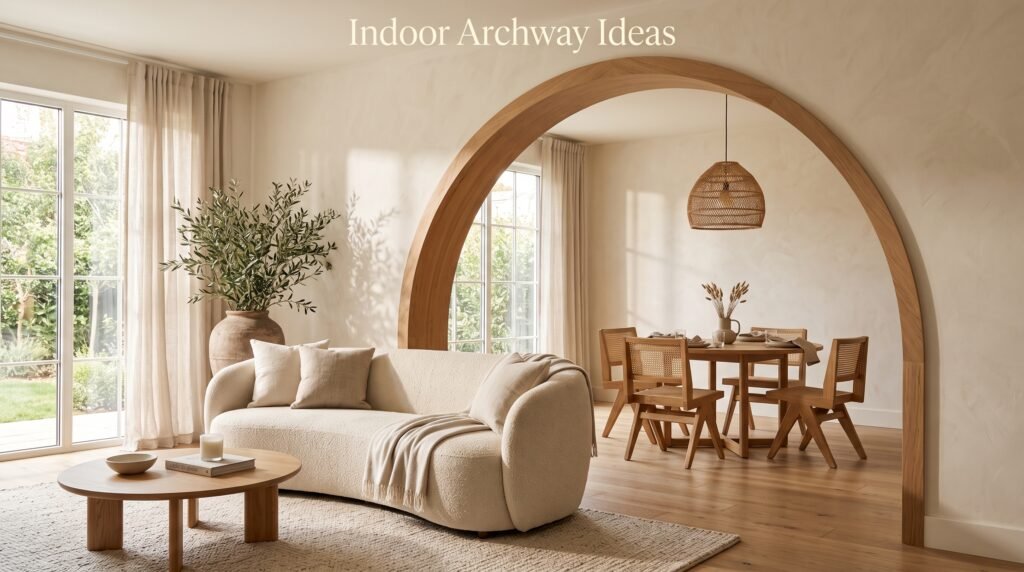
Suggested placement: A bright organic-modern living room looking through a large rounded cream arch into a softly styled dining space.
2. Create a Wide Arch Between Living and Dining Spaces
If you like open-concept living but don’t want your rooms to feel like one enormous space, consider a wide archway.
A large opening can preserve sightlines while subtly establishing where one room ends and another begins. Compared with a rectangular opening, the curved upper corners introduce softness that balances straight furniture lines, cabinetry, windows, and flooring.
The wider the opening, the more architectural it can feel.
For a modern look, avoid heavy moldings around the arch. Instead, allow the wall finish to continue seamlessly around the curve.
Matching flooring across both rooms will further improve visual flow.
You can also use furniture placement to reinforce the division. For example, position a sofa so it faces away from the dining room while keeping the arch visible from the main seating area.
The result feels open without being undefined.
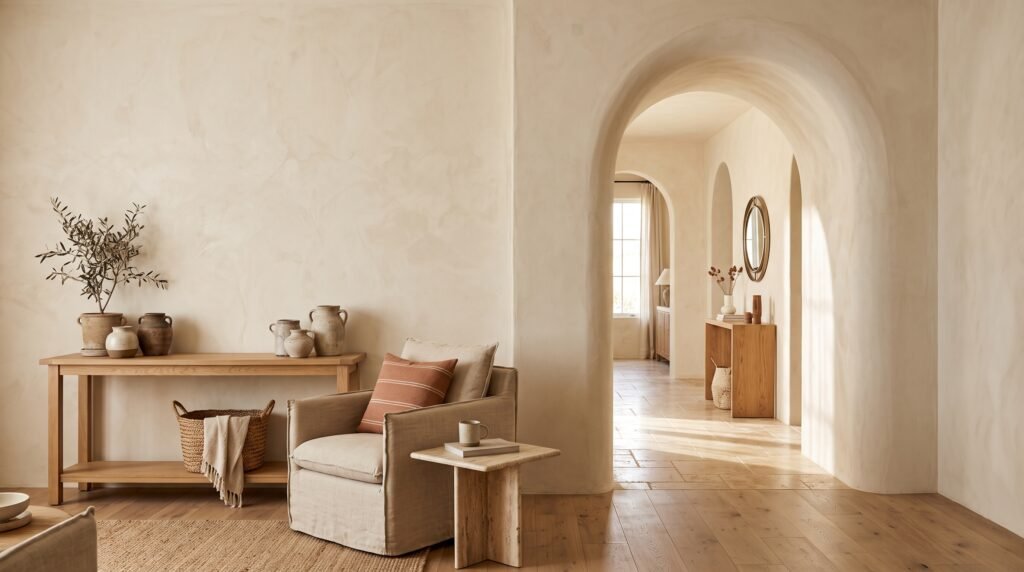
3. Try a Mediterranean-Inspired Plaster Arch
Mediterranean interiors have helped bring arches back into contemporary decorating.
Think soft plaster walls, imperfect textures, warm limestone colors, terracotta accents, natural wood, and gentle architectural curves.
Instead of making the arch perfectly polished, consider a subtle hand-finished plaster texture. Limewash-style finishes can also enhance the effect by creating variations in tone as daylight moves across the wall.
Pair the arch with natural materials such as:
- Travertine
- Oak
- Linen
- Woven baskets
- Handmade ceramics
- Terracotta
- Aged brass
Avoid overcrowding the area with accessories. Mediterranean-inspired interiors often look best when architectural shapes and materials are allowed to become the decoration.
Suggested placement: Warm beige plaster arch connecting a relaxed living room with a sunlit hallway, featuring natural wood, linen and handmade ceramics.
4. Use an Archway to Frame a Beautiful View
An indoor arch doesn’t always have to be the main attraction.
Sometimes its most powerful role is acting as a frame.
Imagine standing in a neutral hallway and seeing a cozy reading chair, large indoor tree, sculptural pendant light, or beautifully styled dining table perfectly centered beyond an archway.
The architecture naturally directs your eye toward the scene.
This technique works particularly well with long sightlines. If you have several connected spaces, carefully consider what will be visible through each doorway.
Try positioning one visually interesting feature at the end of the view.
It might be:
a console table with artwork,
an oversized plant,
a fireplace,
a sculptural chair,
or even a window overlooking the garden.
Suddenly, walking through the home feels more intentional.
5. Add Wood Trim Around an Indoor Arch
Most contemporary arches are finished with plaster or drywall, but adding wood can create a completely different character.
A slim oak border feels clean and contemporary, while darker stained wood creates stronger contrast and works beautifully in traditional or mid-century-inspired spaces.
Wood trim is particularly effective if the same material appears elsewhere in the room.
For example, you could coordinate the arch with:
wood ceiling beams,
built-in cabinetry,
interior doors,
flooring,
or a nearby console.
This repetition helps the arch feel integrated rather than decorative for decoration’s sake.
If you want something subtle, choose wood that is only slightly darker than the surrounding wall.
For a more dramatic approach, pair deep walnut trim with creamy plaster walls.
Suggested placement: Contemporary cream interior with a wide rounded arch edged in natural oak, leading into a minimalist dining room.
6. Introduce Arched Wall Niches
You don’t necessarily need to alter a doorway to bring arches into your interior.
An arched wall niche provides the same graceful shape on a smaller scale.
Niches are perfect for areas where you’d otherwise place a piece of furniture or artwork. They can be shallow and decorative or deep enough to function as storage.
Consider adding one in:
a hallway,
living room,
bedroom,
home office,
or dining area.
Style the niche sparingly.
One sculptural ceramic vase, a stack of books, a small lamp, or an organic branch can be enough.
For a sophisticated monochromatic effect, paint the inside of the niche the same color as the surrounding wall. If you’d like more contrast, use a slightly darker shade inside to create depth.
Integrated lighting can make the niche even more dramatic at night.
7. Create an Arched Reading Nook
An arch can also define a small destination within a larger room.
A recessed reading nook framed by an arch feels cozy because the curved opening visually separates it from the main space.
Inside, include a comfortable chair or built-in bench, small side table, reading lamp, and a few carefully selected textiles.
If the nook is deep enough, built-in shelves can turn it into a miniature library.
Keep the palette connected to the main room so the nook doesn’t feel disconnected. For example, if your living room uses cream upholstery and warm oak furniture, repeat those materials inside the reading area.
The architectural enclosure already provides plenty of visual personality.
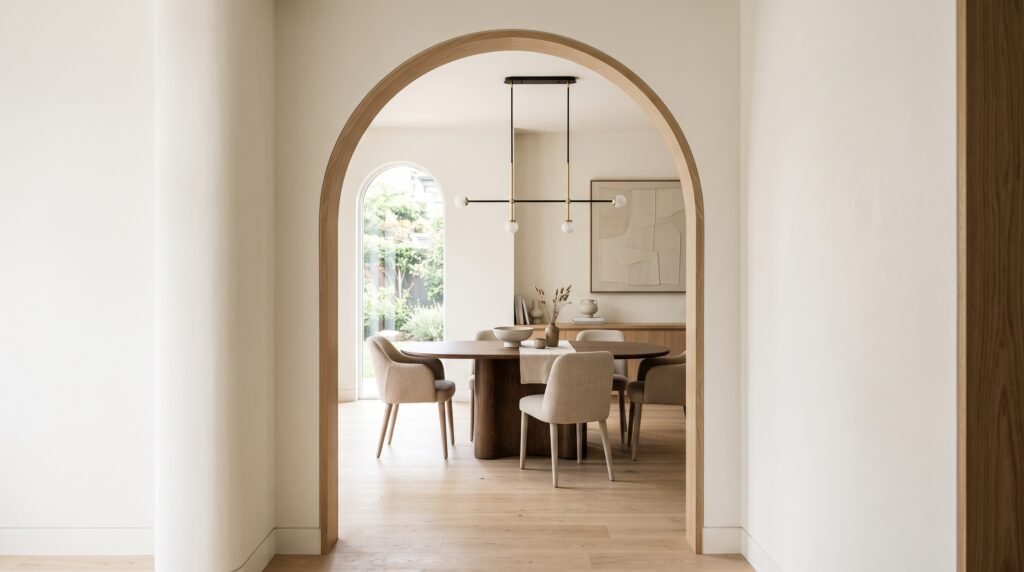
Suggested placement: Built-in arched reading nook with boucle chair, small oak table, books, warm wall light and neutral textured fabrics.
8. Make a Small Hallway More Interesting
Hallways are frequently overlooked when decorating a home.
Yet they are ideal locations for architectural details because they connect multiple spaces.
Adding an arch at the beginning or end of a hallway immediately creates a sense of transition.
In a narrow hallway, avoid extremely thick borders or dark finishes that could make the space feel tighter. A clean plaster arch painted the same light shade as the walls will maintain openness.
Continue the visual effect with simple styling.
A runner rug can draw your eye through the opening, while a pendant light positioned beyond the arch gives the hallway a focal point.
If space allows, place a narrow console against one wall with a small piece of art above it.
The arch does most of the decorative work.
9. Combine an Archway With Built-In Shelves
Built-in storage and arches are a particularly attractive combination.
Instead of placing standard rectangular shelving beside a doorway, you can use curved forms to connect the two architectural elements.
One option is to create a central archway surrounded by symmetrical built-in shelves.
Another is to introduce several arched bookshelf openings across an entire wall.
This can transform an otherwise ordinary living room into something that feels custom designed.
For a modern look, keep shelving relatively thick and uncluttered. Style it with a curated mix of books, ceramics, small artwork, and natural objects rather than filling every shelf.
Painting the shelving and arch in one continuous color can make the installation look especially sophisticated.
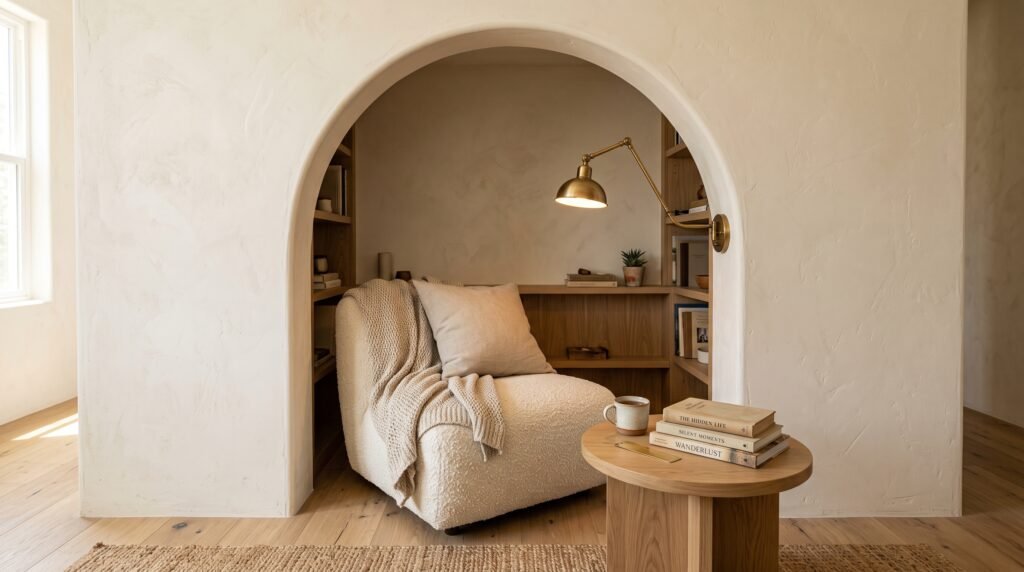
Suggested placement: Elegant living room wall with central rounded doorway surrounded by symmetrical cream built-in shelves styled with books and ceramics.
10. Try a Double Archway
One arch is beautiful.
Two arches can create a genuine architectural statement.
Double archways work especially well across wide walls where a single opening would feel disproportionately large. A narrow structural section between the two openings provides rhythm while still maintaining connectivity between spaces.
This approach can be used between a living room and dining room or between a hallway and a large communal space.
Symmetry is important here.
Keep both arches the same height, width, and curve whenever possible.
Furniture placement can then reinforce the balanced architecture.
For instance, center a dining table beyond the arches or arrange two lounge chairs so they visually correspond with the openings.
The result can feel almost villa-like while remaining completely appropriate for a contemporary home.
11. Paint the Archway a Contrasting Color
Although neutral arches are popular, you don’t have to make yours disappear into the wall.
Color can turn an architectural feature into a decorative focal point.
You might paint only the inner curve of the opening or extend the color across the entire adjoining wall.
Earthy shades tend to work particularly well with curved architecture.
Consider muted clay, olive, taupe, dusty beige, soft brown, or warm gray.
For something bolder, deep charcoal or forest green can create striking contrast against cream walls.
Just make sure the color connects to another element in the room.
Repeating it in artwork, cushions, rugs, or furniture will help the design feel cohesive.
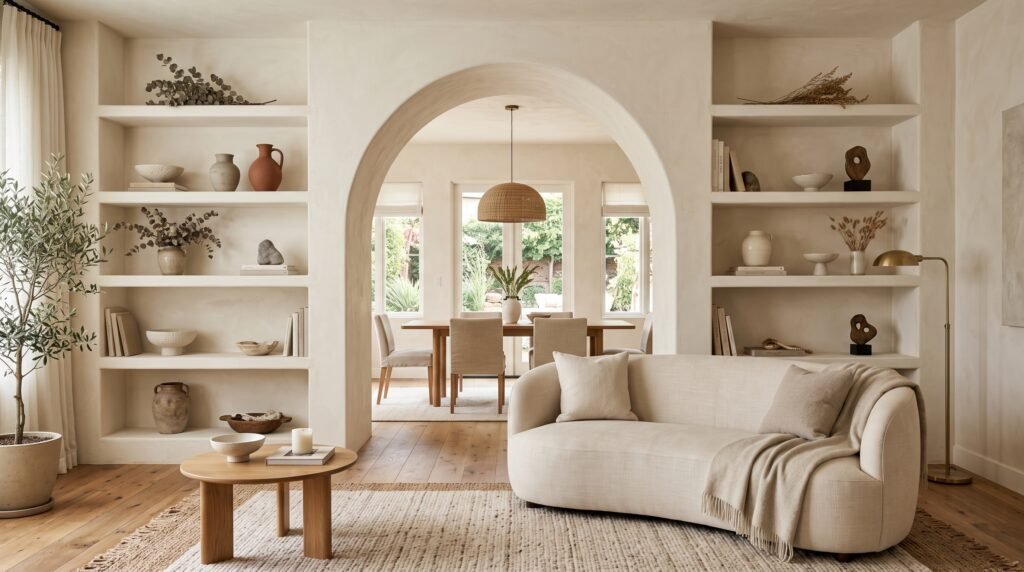
Suggested placement: Warm neutral room with an earthy olive-painted arch framing a lighter dining room beyond.
12. Use Soft Arches in a Minimalist Interior
Minimalist homes can sometimes become dominated by straight lines.
Rectangular sofas, square tables, flat cabinetry, linear windows, and plain walls all contribute to a highly structured appearance.
An arch introduces exactly the opposite.
Its curve breaks up those rigid lines without requiring additional decoration.
This makes arches especially useful in minimalist interiors.
Keep the opening completely untrimmed and paint it the same color as the surrounding walls. Allow natural light to create subtle shadows around the curved edge.
Then limit nearby furnishings to a few purposeful pieces.
A low-profile sofa, sculptural floor lamp, simple wooden table, and textured rug might be all you need.
The architecture becomes part of the minimalist composition rather than an added decorative element.
13. Create an Arched Home Office Entrance
Home offices don’t always need traditional doors.
If your workspace is positioned away from the busiest parts of the house, an open arch can create a beautiful entrance.
This works particularly well for small offices carved from unused corners, former closets, or sections of larger rooms.
From outside the office, the arch frames the desk and shelving almost like a picture.
Because the office remains visible, keep the interior relatively tidy and coordinate its finishes with the neighboring space.
A built-in wood desk, floating shelves, neutral chair, and small table lamp can create an attractive view.
If privacy occasionally becomes necessary, consider adding a curtain on the office side of the opening.
14. Pair an Archway With Statement Lighting
Lighting can emphasize architectural curves beautifully.
Try hanging a sculptural pendant where it can be seen directly through the arch.
The rounded doorway becomes a frame around the light fixture, producing a layered composition.
This works particularly well in dining rooms.
From the living room, you might see a large paper lantern, linen pendant, or contemporary globe fixture centered above the dining table through the archway.
Keep scale in mind.
A fixture that’s too small can disappear inside a large opening, while something oversized can compete with the curve.
Look for a pendant that occupies enough visual space to become noticeable without blocking the view into the room.
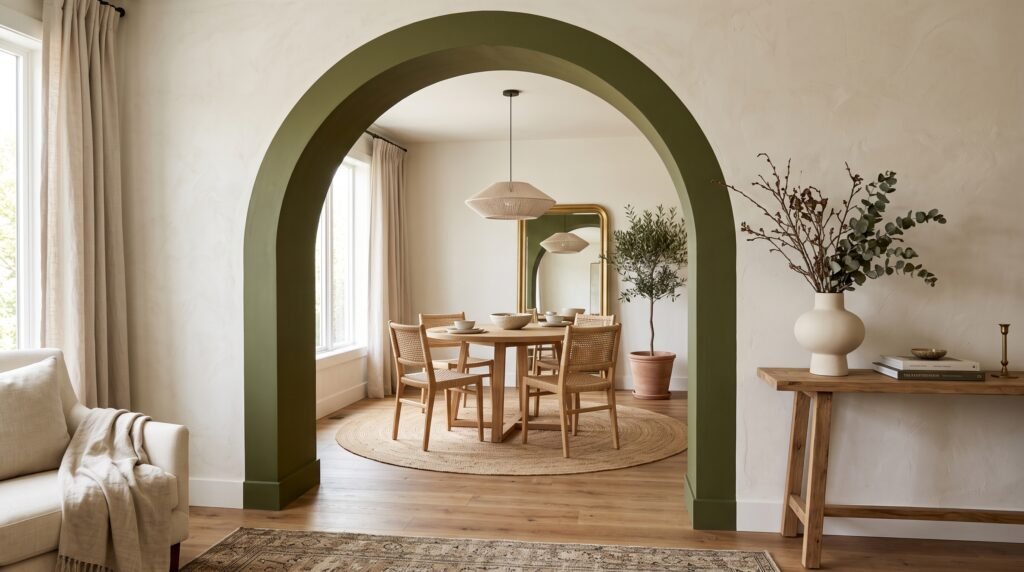
Suggested placement: Cream living room looking through a wide arch toward a dining table with a sculptural oversized pendant light.
15. Use Arches to Soften an Open-Plan Home
Completely open floor plans aren’t right for everyone.
While they maximize space, they can sometimes remove the sense of intimacy that individual rooms provide.
Archways offer a useful compromise.
Instead of removing an entire wall, retain portions of it and create a generous curved opening.
You gain better visual connection while maintaining some architectural separation.
This is especially useful when connecting:
living and dining rooms,
living rooms and entryways,
bedrooms and dressing areas,
or kitchens and breakfast spaces.
The remaining wall sections also provide useful places for furniture, lighting, switches, and artwork.
As a result, an archway can sometimes be more practical than opening the entire wall.
16. Experiment With a Tall Narrow Arch
Not every arch needs to be wide.
Tall, narrow arches have their own elegance.
Their vertical proportions naturally draw the eye upward, which can make ceilings feel taller.
This shape is especially effective for hallway openings, pantry entrances, dressing rooms, and small transitions between rooms.
If you’re designing several openings along one hallway, repeating the same tall arch can create a beautiful architectural rhythm.
Keep the tops aligned and use consistent proportions.
You can then introduce subtle variation through what appears beyond each opening—a plant through one, artwork through another, and a window at the end of the hallway.
The repetition creates structure without making the interior feel repetitive.
17. Build a Statement Arched Feature Wall
If you’re ready to make arches a major design feature, consider an entire architectural wall.
This could combine:
a central arched opening,
built-in shelves,
decorative niches,
concealed lighting,
and integrated storage.
The key is restraint.
You don’t need every opening to be curved. Combining one or two arches with simple rectangular cabinetry often creates a more sophisticated result.
Keep the material palette limited as well.
Warm white plaster combined with oak cabinetry, for example, offers enough contrast while remaining calm and timeless.
An architectural feature wall works particularly well in a large living room where ordinary furniture alone might struggle to fill the visual space.
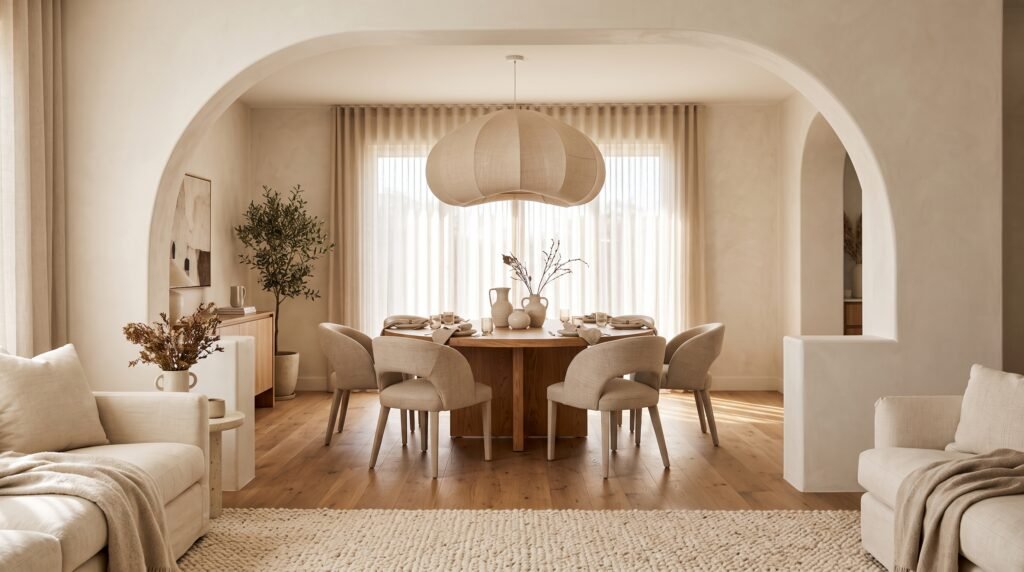
Suggested placement: Luxurious organic-modern living room with large plaster feature wall combining central arch, arched niches, integrated lighting and warm oak cabinetry.
How to Choose the Right Indoor Archway Style
Before adding an arch, consider the existing architectural language of your home.
A Mediterranean-style property might comfortably support textured plaster and broad rounded openings, while a contemporary home may look better with crisp, minimal arches.
Proportion matters just as much as style.
A very small arch on a huge wall can look accidental. Likewise, an oversized opening in a narrow room may leave too little wall space for furniture.
Consider the height of your ceiling, width of the wall, furniture arrangement, and what will be visible through the opening.
The curve itself also deserves attention.
A traditional semicircular arch creates a more obvious architectural statement. A softer curve that begins near the upper corners of a rectangular doorway can feel more contemporary.
If you’re renovating, look at several arch profiles before settling on one.
Small differences in curvature can dramatically change the finished appearance.
How to Decorate Around an Indoor Arch
One of the biggest mistakes with architectural features is feeling that every empty area surrounding them needs decoration.
An arch already creates visual interest.
Give it space.
Instead of surrounding the opening with multiple framed pictures, shelves, signs, and decorative accessories, consider using one or two larger elements.
A console table beside the arch might hold a sculptural lamp and ceramic vase.
A large plant can soften the opposite side.
That’s often enough.
If the opening connects two rooms, pay attention to how their palettes interact. They don’t have to match exactly, but repeating a few materials or colors will create continuity.
For example, oak furniture in one room might be echoed by oak dining chairs in the next.
Cream upholstery could connect with cream curtains.
Black lighting fixtures might appear in both spaces.
These small repetitions allow the arch to frame a view that feels intentional.
Are Indoor Archways Still in Style?
Indoor arches have moved well beyond being a short-lived decorative trend.
Their current popularity is partly connected to a broader shift toward interiors that feel softer, warmer, and more architectural.
For years, many contemporary homes relied heavily on straight lines, white walls, and completely open layouts. Curved architecture provides a way to add personality without filling rooms with additional objects.
Arches also adapt well to different aesthetics.
They can feel old-world when paired with plaster and terracotta, sophisticated with marble and dark wood, relaxed with linen and oak, or highly contemporary when surrounded by minimalist furnishings.
That flexibility gives them staying power.
Instead of focusing on whether arches are currently fashionable, think about whether the shape makes sense for your home’s architecture.
A well-proportioned arch that improves the transition between rooms can remain beautiful long after individual decorating trends change.
Final Thoughts
Indoor archways prove that sometimes the architecture itself can be the decoration.
A simple curve can soften a minimalist room, frame a beautiful view, distinguish adjoining spaces, or turn an ordinary hallway into something memorable.
You don’t necessarily need a dramatic renovation either.
While large openings between rooms make the biggest architectural impact, smaller ideas such as arched niches, reading nooks, built-in shelves, and office entrances can introduce the same character.
For a timeless result, focus first on proportion and placement. Choose a curve that complements your ceiling height and wall dimensions, then use materials and colors that already connect with the rest of your home.
Most importantly, resist the temptation to overdecorate around the finished arch.
Whether you choose a warm Mediterranean plaster opening, a sleek minimalist curve, an oak-trimmed doorway, or a dramatic double archway, give the architecture enough breathing room to stand on its own.
Done thoughtfully, an indoor archway doesn’t simply connect two rooms—it can transform the experience of moving through your entire home.